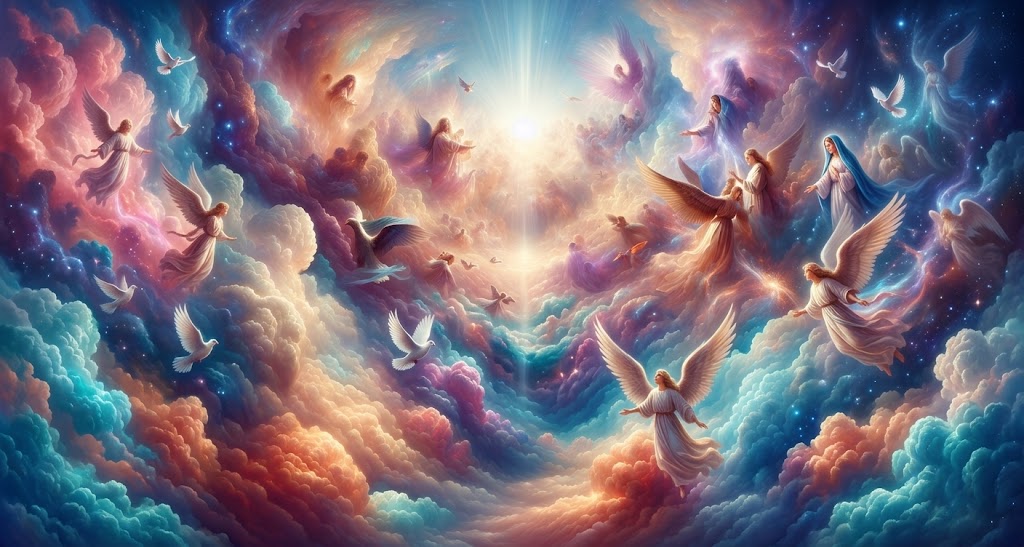






In the beginning, God created the heavens and the earth.
בְּרֵאשִׁיתבָּרָאאֱלֹהִים
01 • THE TEXT
Genesis 1:1–2 — the Prologue of a Seven-Day Chapter
Read this section in the Bible translation of your choice. The analysis below works from the Hebrew text and deliberately avoids treating one English translation as the only possible rendering.
Now the earth was formless and empty, darkness was over the surface of the deep, and the Spirit of God was hovering over the waters.
“And God said” — divine speech initiates every act of the chapter.
“And it was so” — reality conforms to the spoken word.
“And God saw that it was good” — ordered creation is assessed positively, climaxing in Sabbath rest.
02 • THE COSMIC PROLOGUE
A Declaration of Sovereignty Before Anything Exists
The opening pericope of the Hebrew canon functions as a cosmic prologue, establishing the ontological priority of the Creator over both matter and time. Genesis 1:1–2 is not merely a statement of origins; read against its ancient context it works as a polemical declaration of divine sovereignty — the God of Israel is the architect of order in a context of pre-cosmic chaos.
Genesis 1 presents the creation of the cosmos by a singular sovereign God, organized in a seven-day structure: Days 1–3 establish domains, Days 4–6 populate them, and Day 7 rests. The repetition of “And God said,” “And it was so,” and “And God saw that it was good” emphasizes intentional, ordered creation rather than chaos.
The movement: the heavens and the earth → an earth formless and empty → darkness over the deep → the Spirit hovering over the waters → the spoken ordering of Days 1–6 → Sabbath rest.
Verse 2 introduces the three primordial states the rest of the chapter will address: darkness, the deep, and the Spirit hovering over the waters. There is no struggle for creation. The text's focus is on assigning function and domains — the linguistic markers denote total divine authority.
03 • INTERACTIVE VISUAL
Genesis 1:1–2 — the First Two Moves
Select any node. Each one opens a focused lexical and interpretive investigation.
→
→
→
→
→
→
→
UNFORMED→SPOKEN→ORDERED
אֱלֹהִיםבָּרָאבְּרֵאשִׁית
04 • HEBREW LANGUAGE
Three Words Carry the Prologue
בְּרֵאשִׁית bereshit
“In the beginning.” Contextually it can mean an absolute beginning or the starting point of divine ordering — the lack of a definite article has generated a long debate.
בָּרָא bara
“Created.” In biblical usage this verb is reserved for divine creation — God is always its subject.
אֱלֹהִים elohim
“God.” A plural-form noun taking singular verbs here, emphasizing majesty and sovereignty.
תֹהוּ וָבֹהוּ tohu vavohu
“Formless and empty.” The paired description of the earth before ordering — chaos awaiting function.
05 • THE FIRST SENTENCE
Anatomy of a Seven-Word Universe
Genesis 1:1 compresses the whole chapter into a single clause. Reading the Hebrew sequence slowly shows where the text puts its weight: the opening word is about when, the verb is about what only God does, the subject names who acts, and the object names everything that is.
בְּרֵאשִׁיתwhen — in the beginning
→
בָּרָאwhat — created
→
אֱלֹהִיםwho — God
→
THE HEAVENS
& THE EARTHwhat — the totality
& THE EARTHwhat — the totality
Note: many readers observe that “the heavens and the earth” functions as a way of saying “everything” — the whole ordered cosmos, not two items in a list. Whether the verse is a summary heading, a first act, or an absolute statement of origin is part of the debate in section 12.
06 • FORMING / FILLING
The Seven-Day Architecture — Realms, Then Rulers of Realms
The prologue sets the stage for a structured, seven-day framework: Days 1–3 form realms, Days 4–6 fill them with corresponding inhabitants, and Day 7 climaxes in Sabbath rest. This is an influential interpretive framework — an observation about the text's literary architecture, not a requirement that every reader accept a single literary theory.
1 ↔ 4·2 ↔ 5·3 ↔ 6·7 = SABBATH
| Forming | Realm | Filling | Connection |
|---|---|---|---|
| Day 1 | Light / darkness | Day 4 | Sun, moon, stars / luminaries |
| Day 2 | Sky / waters | Day 5 | Birds / sea creatures |
| Day 3 | Land / vegetation | Day 6 | Land animals / humans |
| Day 7 | Rest — the week is crowned, not just completed | ||
The correspondence is explicitly presented in several modern scholarly treatments of Genesis 1; the exact literary and theological significance remains debated.
07 • ANCIENT NEAR EAST
Creation in a World That Already Had Creation Stories
Genesis emerged in the ancient Near East — Mesopotamia and the Levant — a world that already told creation stories. The Babylonian Enūma Eliš depicts divine conflict: Marduk battles the primordial water figure Tiamat and fashions the ordered cosmos from the aftermath. The Atrahasis epic likewise frames humanity's origin inside a drama of divine labor and conflict. Genesis answers that cultural conversation with a strikingly different scene: while ANE myths often involve struggle between gods and pre-existing matter, Genesis depicts an effortless fiat — the God of Israel simply speaks, or hovers. No divine battle is required.
Shared world
- Primordial waters before ordering
- Heaven / earth distinction
- Ordering of an unstructured state
- Humanity within a created order
- Divine rest after the work
What Genesis does differently
- No combat between gods
- Creation by spoken word alone
- One sovereign Creator, not a pantheon
- Order and moral goodness, not victory
- Humanity as image-bearers, not slave-labor
Honesty note: comparative material illuminates the cultural conversation Genesis was born into; it does not by itself prove literary dependence or disprove either text. A responsible comparison asks what cultural assumptions are shared and what theological claims differ — similarity is not automatically copying.
08 • THE COSMOLOGY GENESIS ANSWERS
The Ancient Three-Tier Universe
The world Genesis addresses pictured the cosmos in stacked tiers: the heavens above, a firmament holding back upper waters, the earth between, and the deep below. Genesis 1 works inside that shared cosmological grammar — waters, heaven/earth ordering, darkness and deep — while telling it with a single sovereign God and no rival deities.
The visual is conceptual: it represents the ancient cosmological picture the text's first audience shared, not a claim about physical cosmology.
09 • SCIENCE & FAITH
Different Questions, Carefully Kept Apart
Cosmology asks
How did the universe and its structures originate and develop? Models such as the “Big Bang” singularity describe a beginning of space-time — and readers have often set that in dialogue with the bereshit moment of Genesis 1:1.
Geology & biology ask
How old is the earth, and how do organisms diversify? Discussions of the age of the earth and the compatibility of evolutionary biology with the Genesis narrative belong to this category.
Genesis asks
Who stands behind the ordered world, and what is the world for? The text is interested in sovereignty, order, function and goodness.
The interpretive question
What relationship should be proposed between the theological prologue and modern scientific accounts? Positions range from strict concordist readings to literary/theological readings, with many options between.
Do not confuse categories: Genesis 1 is not a modern cosmology textbook, and scientific models do not by themselves answer the theological and literary questions the prologue raises. Neither direction requires dismissiveness toward the other.
10 • THE CANONICAL TRAIL
“In the Beginning” Does Not Stay in Genesis
→
→
→
→
Scripture deliberately returns to the opening words. John's Gospel echoes “in the beginning” for the Word through whom all things were made; Revelation closes the canon with a new heaven and a new earth. These are canonical and theological links — interpretive connections later writers draw, not textual proof of a single claim.
11 • ARCHAEOLOGY & MATERIAL CULTURE
What Can Archaeology Actually Contribute?
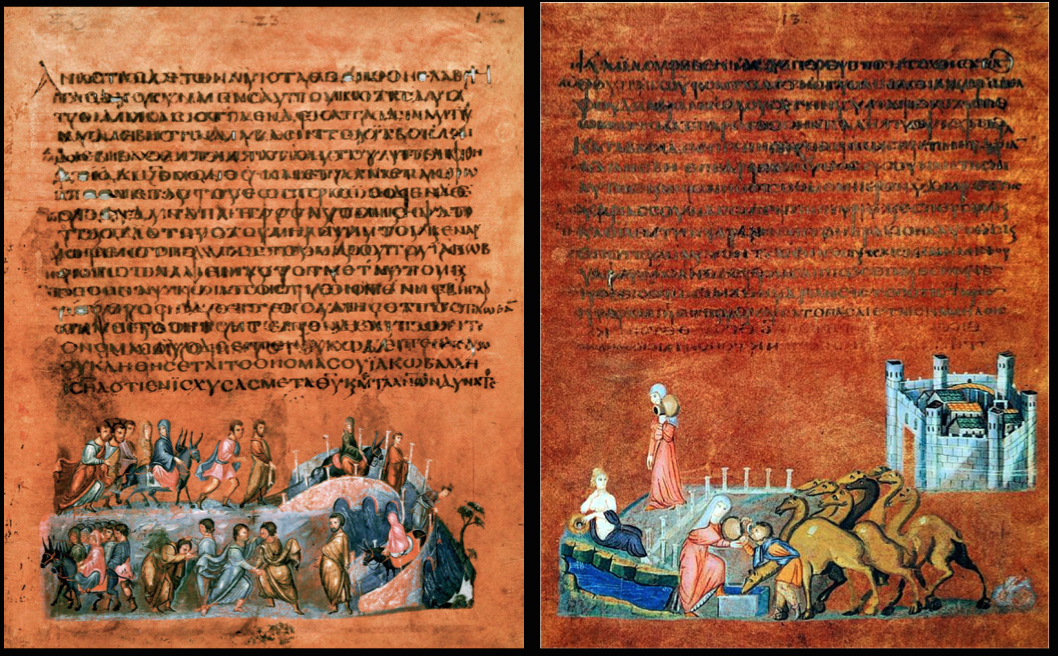
Archaeology cannot excavate “the beginning.” It can, however, recover the texts and objects that carried the ancient creation conversation Genesis speaks into.
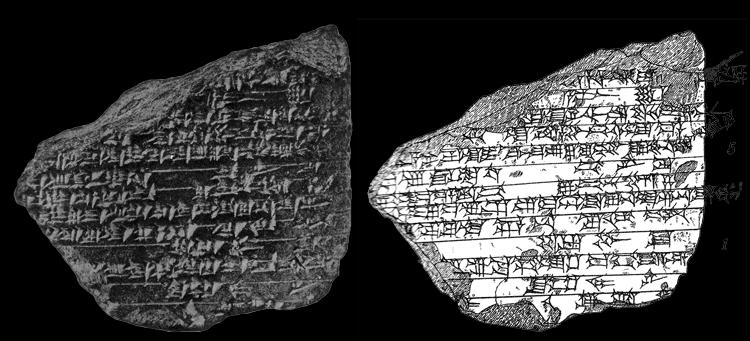
For a production site, individual artifact entries should carry museum/collection, object title, date, culture, accession number where available, provenance, image rights and credit. This Week 1 build does not invent artifact metadata; wanted objects are tracked in the repo's ASSETS.md.
12 • HISTORICAL TIMELINE
Genesis 1:1–2 in Its Larger Conversation
~4000 BCE — Traditional Ussher ChronologyThe traditional/symbolic creation date computed by Archbishop Ussher — a reception-history tradition, not an asserted chronology.
~1800 BCE — Enūma Eliš (Standard Version)The Babylonian creation epic reaches its standard form — the mythic world Genesis answers.
~1446 BCE — Exodus / Traditional CompositionThe traditional early date for the Exodus and the era often associated with Mosaic tradition formation.
Second Temple → Early ChurchThe prologue is read as the foundation of the doctrine of creation; John 1 echoes it for the Logos; creation ex nihilo is later formulated.
Modern EraWalton's functional/cosmic-temple reading, framework interpretations, and the science dialogue keep the debate open.
13 • THE GAMEBOARD
Parallel Timelines — Drag Through Time
Biblical events and human civilization on one stream. Drag to pan, toggle the layers, tilt the board.
Drag & scroll to navigate the stream of time
14 • SCHOLARLY DEBATES
Questions Worth Keeping Open
Creation ex nihilo or functional ordering?
Readers and scholars differ. John Walton argues Genesis 1 is about assigning function — inaugurating a cosmic temple — rather than describing material manufacture, while others maintain a material-physical beginning. The text clearly depicts ordering and differentiation; whether 1:1 also asserts creation from nothing is part of the continuing discussion.
Framework hypothesis or literal 24-hour days?
Are the days topically arranged literary devices — a forming/filling architecture — or chronological, literal periods? The literary pattern is observable; what it implies about chronology remains an interpretive question.
Is bereshit an absolute beginning or a construct state?
The Masoretic form lacks a definite article, which some read as a construct: “In the beginning of God's creating…”. Most scholars favor the absolute “In the beginning…”, but the grammatical question is genuinely open and shapes how verse 1 relates to verse 2.
Does Genesis depend on Enūma Eliš?
The parallels are real — primordial waters, heaven/earth ordering — but so are the contrasts: no combat, one sovereign God, effortless speech, humanity as image-bearers. Comparison is valuable precisely because similarity does not automatically prove copying.
15 • RABBIT HOLES
Where the Investigation Can Go Next
16 • SEEK ETERNITY
Who Was There Before the Beginning?
Genesis 1:1–2 presents more than an origin claim. Before any realm is formed or filled, the text has already established its central fact: a sovereign God who needs no opponent, no raw material, and no struggle — only a word.
Whether one reads the prologue as an absolute beginning, a functional ordering, a literary architecture, or some combination, the text repeatedly draws attention to priority, sovereignty, order and intent.
The investigation does not end with “What was made first?”
It asks who was already there — and what that means for everything after.
17 • SOURCES & FURTHER READING
Research Trail
- John H. Walton, The Lost World of Genesis One (2009).
- Gordon J. Wenham, Genesis 1–15, Word Biblical Commentary (1987).
- Bruce K. Waltke, Genesis: A Commentary (2001).
- Enūma Eliš and the Atrahasis epic — Babylonian creation literature (comparative material).
Content for this week was transcribed faithfully from the site's existing Week 1 study archive (the gen1-week1 studyArchive entry and the genesis1Weeks hub module) plus the Genesis 1:1–2 “Primordial Beginning” pericope extract. No new claims were introduced beyond those sources.